Forum on the Arms Trade
  • Home
  • Experts
  • Emerging Experts - Global Program
  • Expertos y Expertas Emergentes - Latino América
  • Support
  • Ask the Arms Experts
  • Annual Conference 2026
  • Events
  • U.S. Arms Transfers to Israel - Trump
  • Biden Arms Transfers To Israel
  • Jobs Corner
  • Journalists
  • Major Arms Sales Notifications Tracker
  • U.S. Conventional Arms Transfer (CAT) Policy
  • U.S.-Saudi Arms Sales
  • U.S. Arms Sales to Taiwan
  • U.S. Arms Sales to India
  • U.S. Landmine Policy
  • Resource Page - Under Threshold Arms Sales
  • Resource Page - USML Cat I-III to Commerce
  • HD State Tracker
  • Get on the list
  • About
  • Archives
    • All archives
    • Newsletter
    • Blog

A View from Brazil: Trump's First 100 Days

5/3/2017

2 Comments

 
This video blog is the tenth entry in a series examining actions during the first 100 days of the new Trump administration and their possible implications on the arms trade, security assistance and weapons use in the future.
Muggah
Robert Muggah
In this video interview, Robert Muggah addresses these questions, at markers indicated below:

0:07  What is Brazil's involvement in the arms trade?
1:39  
How is President Trump perceived in Brazil?
4:18  Do you have concerns about what you're seeing?
6:14  What advice do you have for the Trump administration?


Robert Muggah is Co-founder & Research Director at Igarapé Institute and the SecDev Foundation
2 Comments

Trump’s First 100 Days of Foreign Military Sales Notifications Were More Than Eight Times That of Obama’s - No Restraint in Sight

5/1/2017

2 Comments

 
AbramsonJeff Abramson
This is the eighth entry in a series examining actions during the first 100 days of the new Trump administration and their possible implications on the arms trade, security assistance and weapons use in the future.

Occurring under the news radar, the general public was notified last Friday afternoon of an additional $2.6 billion in proposed foreign military arms sales, bringing the Trump administration’s first 100 day total to more than $6 billion. That figure dwarfs President Obama’s first 100 days, which included notifications totaling just $713 million.
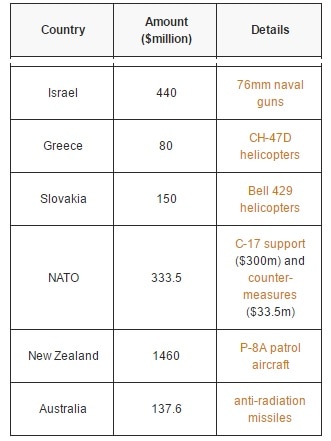
FMS notifications that went online Friday, April 28
Recent FMS Notifcations
The Forum on the Arms Trade’s notification tracker maintains an overview and online spreadsheet of proposed government-to-government arms sales and services through the Foreign Military Sales (FMS) program. While just one of many sources of arms transfers, the FMS program is typically the largest and most visible, offering a good indication of what countries will be priority arms trade partners for the United States in the coming years.

The value of FMS notifications this calendar year totals nearly $6.7 billion (note: $418 million of which was officially notified the day before Donald Trump took office). While many of these potential arms sales were already in the works, the pace of notifications suggest that the weapons trade will be a significant part of the president’s approach to foreign policy. Tellingly, nearly half ($3.1 billion) of the potential sales are to countries in the Middle East (Iraq, Israel, Kuwait, and Saudi Arabia) for pilot training, missiles, helicopters, naval guns, equipment for artillery and infantry troops, and other weapons and services. Other countries included so far in 2017 FMS notification are Australia, Canada, Greece, Kenya, NATO, New Zealand, Singapore, Slovakia, South Korea, and the United Kingdom.

At the hundred-day marker of Obama’s first term, FMS notifications only included Australia ($560 million) and Mexico ($93 million and $60 million) for helicopters and patrol boats. By the time his presidency ended, Obama had proposed approximately $430 billion in FMS, including a record-setting $103 billion in 2010 alone -- the vast majority of that going to Saudi Arabia.  

Given the United States’ dominance of the global arms trade market and the Obama administration’s high level of sales, it might have been difficult to expect a Trump presidency to further expand U.S. arms transfers. But that now appears likely as this administration moves controversial deals to Saudi Arabia and Bahrain that Obama had put on hold. While not yet publicly notified, they are making their way through Congress. Deals to those countries, especially without preconditions, would appear to only reward suppression of human rights (Bahrain) and reckless engagement in fighting that fails to protect civilians (Saudi Arabia). Unless Congress chooses to exercise its authority over arms agreements and deliveries, there appears to be no restraint in sight.    

Jeff Abramson is a senior fellow at the Arms Control Association and coordinates the Forum on the Arms Trade.
2 Comments

Trump on Arms Sales

4/25/2017

1 Comment

 
This is the third entry in a series examining actions during the first 100 days of the new Trump administration and their possible implications on the arms trade, security assistance and weapons use in the future.
Stohl
Rachel Stohl
Dick
Shannon Dick
Three months into the Trump administration and President Trump has used arms sales to support security priorities and demonstrate a commitment to industry. Yet it remains unclear how and to what extent arms sales will be used as a tool of Trump’s foreign and defense policies.

Recent actions, however, appear to suggest that human rights will no longer be a priority for advancing or withholding U.S. arms sales and thereby supporting larger U.S. foreign policy interests. Indeed, since taking office, the Trump administration has pushed forward (but Congress has yet to fully review) arms sales to Saudi Arabia, Bahrain, and Nigeria that were previously put on hold by the Obama administration due to human rights concerns. The rationale behind these decisions to provide U.S. weapons to consistent human rights violators is largely based on counterterrorism priorities and the view that these arms transfers will significantly support campaigns against terrorist groups. But there is scant evidence that allowing these arms sales will contribute to U.S. strategic goals and objectives and will not result in further human rights abuses and civilian suffering. For example, the Saudi-led bombing campaign in Yemen has resulted in devastating impacts on the Yemeni civilian population. The campaign, undertaken with U.S. supplied weapons, has consistently struck civilian targets and could help fuel anti-American sentiment and play into terrorist groups’ narrative, ultimately working against larger interests in working to stabilize the country and end the conflict.

The Trump administration is also trying to change the bureaucratic process surrounding arms sales to foreign governments. Reportedly, the Trump administration is considering replacing foreign military financing  (FMF) grants with loans. The Trump administration seems to believe that having governments pay back their weapons purchases will save the United States money in the long run. However, such thinking fundamentally misunderstands the intent of the FMF program. FMF enables foreign governments to use U.S. government grants to purchase U.S. weapons primarily through the Foreign Military Sales program. The program is often used to support foreign militaries that would otherwise be unable to purchase U.S. systems and is often cited as a crucial means to promote national security interests. Indeed, FMF allows foreign partners and allies to acquire U.S. equipment – which is often more expensive than systems from other countries – and thus augment their own military capabilities while fostering stronger security relations with the United States.

Additionally, because FMF funds are almost exclusively reserved for the procurement of U.S. weapons and equipment, the program supports U.S. industry. As Andrew Shapiro, former Assistant Secretary of State for Political-Military Affairs under the Obama administration, aptly noted in commentary for Defense News, the FMF program “helps maintain the U.S. defense-industrial base, it helps lower the cost for the U.S. to buy systems if there is a broader base of sales, and that impacts jobs and communities.” Should the administration follow through with converting grants to loans, it could harm U.S. industry and lead business into other markets that offer less expensive alternatives, such as those maintained by Russia and China. In its budget blueprint, the administration stated that the shift to loans would “potentially [allow] recipients to purchase more American-made weaponry with U.S. assistance, but on a repayable basis.” But why would buyers pay for systems they used to get for free, and in fact pay more than if they were to seek military equipment from other suppliers?

The Trump administration’s initial arms sales efforts may work to weaken long-standing U.S. policy priorities regarding conventional arms transfers. In the short term, Trump’s policy decisions are minimizing the extent to which human rights concerns are taken into consideration.  In the long-term, these arms sales may result in continued sales to a wider scope of actors with poor records of good governance. Additionally, in seeking changes to grant programs, Trump’s policies may undercut U.S. industry. Such decisions could ultimately backfire on U.S. interests, both economically and politically, and leave an arms trade legacy that risks negative consequences for years to come.

Rachel Stohl is a director of the Conventional Defense program at the Stimson Center.
Shannon Dick is a research associate at the Stimson Center and and a participant in the Forum’s emerging expert program.

Note: this post was edited at 12:11PM EDT on April 26 to clarify the status of the sales to Saudi Arabia, Bahrain and Nigeria.


1 Comment

The "business as usual" approach to arms sales? That’s so last year

1/10/2017

2 Comments

 
​This is the eighth blog post in a series looking at an array of issues in 2017 related to weapons use, the arms trade and security assistance, at times offering recommendations.
Picture
Allison Pytlak
You don’t have to be an arms control wonk to have noticed that 2016 was peppered with headlines about the sale of weapons to places they shouldn’t be and used in any number of horrific ways against soldiers and civilians alike. Many of these stories zeroed in on the double standards in play; namely that vendors of such weapons are some of same countries that had only recently championed the adoption of new legally binding standards on the arms trade in order to prevent such atrocities from occurring. The international community as a whole has largely failed to hold states to account for these transfers, yet a mushrooming of national-level advocacy has helped to bring the policy and practice of some countries better in line with their legal obligations. As always, there are a few outliers but as the new year begins, that club might just be shrinking.

Over the years many measures have been put into place to better regulate the international arms trade, usually by requiring governments to assess the impact of their arms transfers before they fully authorize them. At a global level the culmination of such efforts is the 2013 Arms Trade Treaty (ATT), an international agreement that built on good national and regional practices to establish a single global standard by which to assess the risks associated with transferring arms and to stop them from going to places they shouldn’t.

Lauded by many in the international community, the ATT has generated significant optimism that a corner had been turned and that humanitarian considerations would play the role that they ought to within the international arms trade.

This is why it has been extremely disappointing to see that many of the same countries that championed the ATT took a business as usual approach to their arms transfers in 2015 and 2016. This was especially notable with respect to transfers to Saudi Arabia from countries such as Canada, France, Germany, Italy, Spain, the United Kingdom (UK), and the United States (US) – although transfers to other countries have also caused concern. Saudi Arabia’s human rights record, both domestic and international, is widely condemned. The ATT is meant to prevent arms transfers where there is a substantial risk that those arms would be used in specific negative ways, such as perpetuating war crimes, human rights abuse or genocide, among other actions.

Many of these transactions took place in 2015. Some continued last year but 2016 also saw important actions being taken in national parliaments to push back on them. The Netherlands, for example, instituted a presumption of denial against transfers to Saudi Arabia, and the Spanish Congress passed a motion calling on the acting government to deny and revoke licenses to all parties to the conflict. Switzerland, Sweden and parts of Belgium have also either stopped authorizing licenses or denied them. Other countries however, notably Canada, France, the UK and the US have proceeded as normal.

So will 2017 bring more of the same?

The answer depends partly on where you look. For example, efforts to address this situation in an official way under the ATT, such as at its annual conference of states parties last August, were unsuccessful. Civil society united around efforts to see this addressed as part of the formal agenda and when that failed, utilized side events, media and bilateral advocacy meetings to make the point that such transfers are contrary to Treaty obligations for those countries that have joined. This should have been the single most relevant opportunity to take up the matter of treaty compliance but instead it was awkwardly shoved under the carpet.

As already mentioned, there are several national processes underway meant to hold governments accountable to their international commitments, similar to the approaches described above.  In looking ahead to 2017, these include a High Court hearing scheduled for early February in the United Kingdom on the legality of continued arms sales to Saudi Arabia in the light of Saudi violations of International Humanitarian Law (IHL) in Yemen. Italian civil society is continuing to strive to curtail Italian exports to Saudi Arabia through parliamentary channels and the media. A legal challenge has also been presented in Canada, following Ottawa’s decision last year to move ahead with a deal authorizing the sale of light armoured vehicles to Saudi Arabia, even as it moves to finalize its ATT accession and has publicly condemned the country’s human rights record. The timing of the accession and the legal challenge bring these transfers under heightened scrutiny from media, civil society and legislators – which may be the means by which the deal could be stopped, although no one is holding their breath.

Tragically, the deepening famine in Yemen, coupled with growing evidence of foreign-made arms being used there indiscriminately by Saudi-led coalition forces, is finally starting to percolate through to the attention of the general public which, in turn, is putting pressure on policy makers. Public opinion could also be a factor that may shift government positions in 2017. In the United States for example, a decision was taken in December to "hold up" a sale of precision-guided munitions to Saudi Arabia out of concern for the kingdom’s continuing air strikes on civilian targets. It will continue to refuel Saudi aircraft that are a part of the Yemen bombing campaign though and other sales remain in place, which makes this a half-measure. The US is a signatory to the ATT and has in place its own export laws.

There may also be recourse through somewhat under-explored channels like reports by the UN High Commissioner for Human Rights on arms transfers law and human rights law, and through regional bodies such as the European Union, whose parliament voted for an arms embargo on Saudi Arabia last year.

All of this is very positive but national actions cannot become a replacement for multilateral accountability. More must be done to uphold existing international law in the first place via the institutions that were created for that purpose. If states continue to avoid implementing their obligations thoroughly, and if those that are in compliance do not make better use of these agreements to address breaches of them, then they will collectively devalue the very mechanisms that they have put so many resources into creating.

Taken together, it’s obvious that there are ample tools with which to push back against a business as usual approach in 2017 from those who still defend it. The real question is if there is enough political will.

Allison Pytlak is a Program Manager in the disarmament program (Reaching Critical Will) of the Women’s International League for Peace and Freedom


2 Comments

Court Action to Implement the Arms Trade Treaty

12/19/2016

2 Comments

 
This is the fifth blog post in a series looking at an array of issues in 2017 related to weapons use, the arms trade and security assistance, at times offering recommendations.
Picture
Roy Isbister
In the United Kingdom (UK), a major feature of the first quarter of 2017 will be the High Court hearing at the start of February on the legality or otherwise of continued UK arms sales to Saudi Arabia in the light of Saudi violations of International Humanitarian Law (IHL) in Yemen. In June 2016, The Campaign Against the Arms Trade (CAAT) was granted permission to seek judicial review of the UK government’s arms export licensing decisions with regard to Saudi Arabia. In the past 18 months, the UK has licensed more than £3.3 billion of arms exports to Saudi Arabia, a significant proportion of which has comprised Paveway IV bombs and Typhoon combat aircraft for use by the Royal Saudi Air Force (RSAF).

This comes against the background of intense conflict in Yemen. A 10-State Saudi-led coalition began its military intervention in Yemen in March 2015, after Houthi rebels, in alliance with former President Ali Abdullah Saleh, took control of the capital Sana’a and ousted current President Abd Rabbo Mansour Hadi. The Houthi-Saleh alliance swept south to take control of key cities including Aden. The country was quickly engulfed by violence, marking the end of a fragile political transition process.

From very early on in the Saudi-led bombing campaign, regular reports began to emerge of airstrikes on critical civilian objects, residential areas, and large gatherings of civilians, including Mazraq IDP camp, and relief supplies warehouses, attacks on the Old City of Sana’a. These regular attacks against civilians and civilian objects, along with the use of cluster munitions (which the UK Government may be on the verge of acknowledging for the first time), the designation of entire cities as military targets, and other practices collectively demonstrated a pattern of violations of IHL. The Houthis have also committed apparent IHL abuses, firing artillery and missiles at civilian areas in Saudi Arabia and in Yemen. All other parties to the conflict appear to have similarly committed violations of IHL.

On the basis of the scale of problems related to bombings in Yemen, in December 2015, Saferworld, with Amnesty International and Oxfam, sought a legal opinion from Matrix Chambers. The opinion found that the UK government had “misdirected itself in law” on continued arms sales to Saudi Arabia.  Citing Article 6.3 of the Arms Trade Treaty (ATT), Matrix concluded the Government had knowledge that its arms would be used to breach IHL, and that therefore such sales were prohibited. Matrix further concluded, having examined a series of potential breaches of IHL by the RSAF, that even if the “knowledge test” for prohibiting sales under Article 6.3 was not met, the standard of “overriding risk” that UK arms would be used to commit serious violations of IHL had been met, and any reasonable risk assessment would conclude that sales to Saudi Arabia of any controlled equipment at risk of being used in the conflict in Yemen should be stopped.

When CAAT moved for judicial review, the Government sought to quash the hearing on the grounds that it had access to information not available to the UN or the public that explained Saudi actions as consistent with IHL. However the judge, in insisting that were grounds for judicial review and that the hearing should be expedited, said there was abundant evidence of breaches of IHL that the government had to take into account. He was particularly referring to UN reports citing many IHL violations.

The case will be extremely important. The UK Government has pursued an extremely narrow consideration of IHL in performing risk assessments for arms export licensing. Lawyers have advised that this is in line with a near twenty-year attempt by the UK and other Western governments to narrow the scope of IHL, rowing back on seventy years of international jurisprudence. Recognizing the importance of this case for all their years of campaigning work, Amnesty International and Human Rights Watch will also be presenting arguments. All feel they can raise issues that the court needs to consider that make CAAT’s success more likely.

A defeat for the Government will clarify that the risk to IHL of arms transfers cannot be set aside due to other considerations, and will potentially help give meaning to the relevant articles of the ATT.  This may also have particular implications for other EU member states, as UK law is in addition subject to shared obligations under an EU instrument (the Common Position). 

The recent US decision to stop the supply of precision-guided weapons to the RSAF and to limit certain intelligence-sharing due to systematic and endemic failures in targeting will be a considerable boost to CAAT.  Under the US system, the President can send a ”signal” to the Saudi Government by refusing certain arms sales at the same time as continuing to support the Saudi air campaign by other means (e.g. by refuelling Saudi aircraft).  However the UK does not have this option.  For the UK, national law, the EU Common Position and the ATT all agree that whenever there is a clear risk that the arms in question might be used to commit or facilitate serious violations of international humanitarian or human rights law, a proposed transfer must be refused.  So if there are “systemic, endemic” problems with Saudi targeting in Yemen, all transfers of arms from the UK that might be used by the RSAF will have to be stopped.  Parliament is already asking why the UK is ignoring what the Obama administration has determined.  The court will undoubtedly ask those questions too. Hopefully, 2017 will begin with a UK High Court ruling that substantially strengthens the ATT.

Roy Isbister heads Saferworld’s Arms Unit.
2 Comments

U.S. Arms Transfers and Military Training in the Middle East and North Africa

3/11/2015

2 Comments

 
William HartungWilliam Hartung
The United States is the largest supplier of weapons and training to the Middle East/North Africa (MENA) region, and is likely to remain so over the next few years. But there has been no comprehensive effort to assess the potential impacts of these transfers, which range from tens of billions of dollars in deals with Saudi Arabia to the evolving program to train and equip a 5,000-strong force of Syrian moderates to fight ISIS.

The need for closer monitoring and control of U.S. transfers to the region is underscored by recent cases such as the use of U.S.-supplied weaponry to put down the democracy movement in Bahrain and the surrender of large quantities of U.S.-supplied weaponry to ISIS by U.S.-trained Iraqi security forces. But despite these warning signs, it is likely that U.S. transfers to the region will continue to grow in the context of building and sustaining a coalition against ISIS.

U.S. transfers of arms and training to the region must also be seen in the context of the activities of other suppliers. In the midst of the violence rocking the region, is there a room for a policy of greater restraint in arms transfers on the part of its major arms suppliers, or will such efforts have to await a resolution of major ongoing conflicts like the Syrian civil war?

William Hartung is Director of the Arms and Security Project at the Center for International Policy.

2 Comments
Forward>>

    About

    The "Looking Ahead Blog" features comments concerning short- to medium-term trends related to the arms trade, security assistance, and weapons use. Typically about 500-1000 words, each comment is written by an expert listed on the Forum on the Arms Trade related to topics of each expert's choosing.

    We have a number of special series including: 


    Looking Ahead 2026
    Looking Ahead 2025
    Looking Ahead 2024
    Looking Ahead 2023
    Looking Ahead 2022
    ​Looking Ahead 2021
    Looking Ahead 2020

    Looking Ahead 2019
    Looking Ahead 2018
    First 100 Days (April/May '17)

    Looking Ahead 2017

    Inclusion on the Forum on the Arms Trade expert list does not indicate agreement with or endorsement of the opinions of others. Institutional affiliation is indicated for identification purposes only.

    Archives

    October 2026
    August 2026
    July 2026
    June 2026
    February 2026
    December 2025
    November 2025
    May 2025
    February 2025
    January 2025
    December 2024
    November 2024
    September 2024
    March 2024
    January 2024
    November 2023
    October 2023
    August 2023
    April 2023
    March 2023
    February 2023
    January 2023
    December 2022
    September 2022
    August 2022
    May 2022
    April 2022
    February 2022
    January 2022
    October 2021
    September 2021
    August 2021
    July 2021
    April 2021
    January 2021
    July 2020
    May 2020
    January 2020
    December 2019
    July 2019
    April 2019
    January 2019
    December 2018
    May 2018
    December 2017
    May 2017
    April 2017
    January 2017
    December 2016
    October 2016
    June 2016
    May 2016
    April 2016
    June 2015
    May 2015
    March 2015

    Pdf's

    March 11 (2015)

    Categories

    All
    Adam Isacson
    Africa
    Alejandro Sanchez
    Allison Pytlak
    Amy Nelson
    Anna Stavrianakis
    Arms Sales
    Arms Trade Treaty
    Arms Trafficking
    Aude Fleurant
    Bonnie Docherty
    Brian Castner
    Child Soldiers
    Colby Goodman
    Corruption
    Cyber
    Dan Gettinger
    Danielle Preskitt
    Divestment
    Doug Weir
    Drones
    Emerging Experts
    End-use Monitoring
    Environment
    Erin Hunt
    Europe
    Exploration Of Arms Reduction And Jobs
    Explosive Weapons
    First 100 Days
    Frank Slijper
    Gender
    Global Trade Trends
    Harm To Civilians
    Hector Guerra
    High School Debate '19 20
    High School Debate '19-20
    Humanitarian Disarmament
    Human Rights Due Diligence
    Iain Overton
    Investors
    Jeff Abramson
    Jen Spindel
    Jobs
    John Lindsay Poland
    John Lindsay-Poland
    Jordan Cohen
    Kate Kizer
    Killer Robots
    Landmines/cluster Munitions
    Latin America
    Laura Boillot
    Lode Dewaegheneire
    Looking Ahead 2017
    Looking Ahead 2018
    Looking Ahead 2019
    Looking Ahead 2020
    Looking Ahead 2021
    Looking Ahead 2022
    Looking Ahead 2023
    Looking Ahead 2024
    Looking Ahead 2025
    Looking Ahead 2026
    Maria Pia Devoto
    Martin Butcher
    Matthew Bolton
    Middle East
    Military Expenditures
    Natalie Goldring
    Nicholas Marsh
    Non State Actors
    Paul Holtom
    Rachel Stohl
    Ray Acheson
    Robert Muggah
    Robert Watson
    Roy Isbister
    SALW
    Samuel Perlo Freeman
    Samuel Perlo-Freeman
    Security Assistance
    Seth Binder
    Shannon Dick
    Suicide Bombing
    Summit For Democracy
    Sustainable Development
    Tobias Bock
    Transparency
    Ukraine War
    UN Register
    Victim Assistance
    Wanda Muñoz
    War In Ukraine
    William Hartung
    Wim Zwijnenburg
    Yeshua Moser-Puangsuwan

    RSS Feed

Proudly powered by Weebly